
When Ethereum completed The Merge and moved to Proof of Stake, it didn't just swap consensus mechanisms — it introduced an entirely new piece of protocol machinery called the Sync Committee. It's foundational to how light clients work, yet almost nobody watches it in real time.
We built ethsync.wtf to fix that.
What is the Sync Committee?
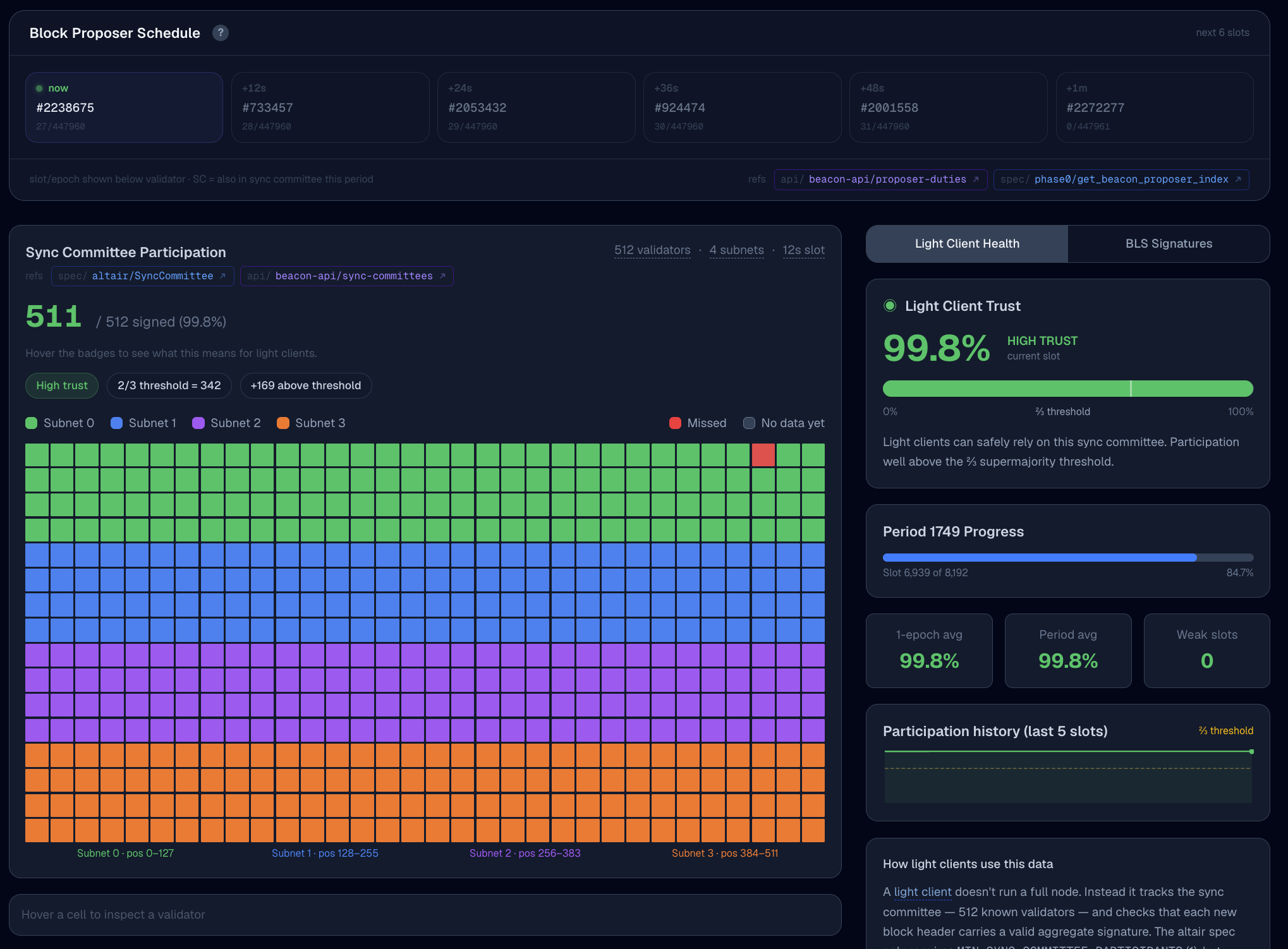
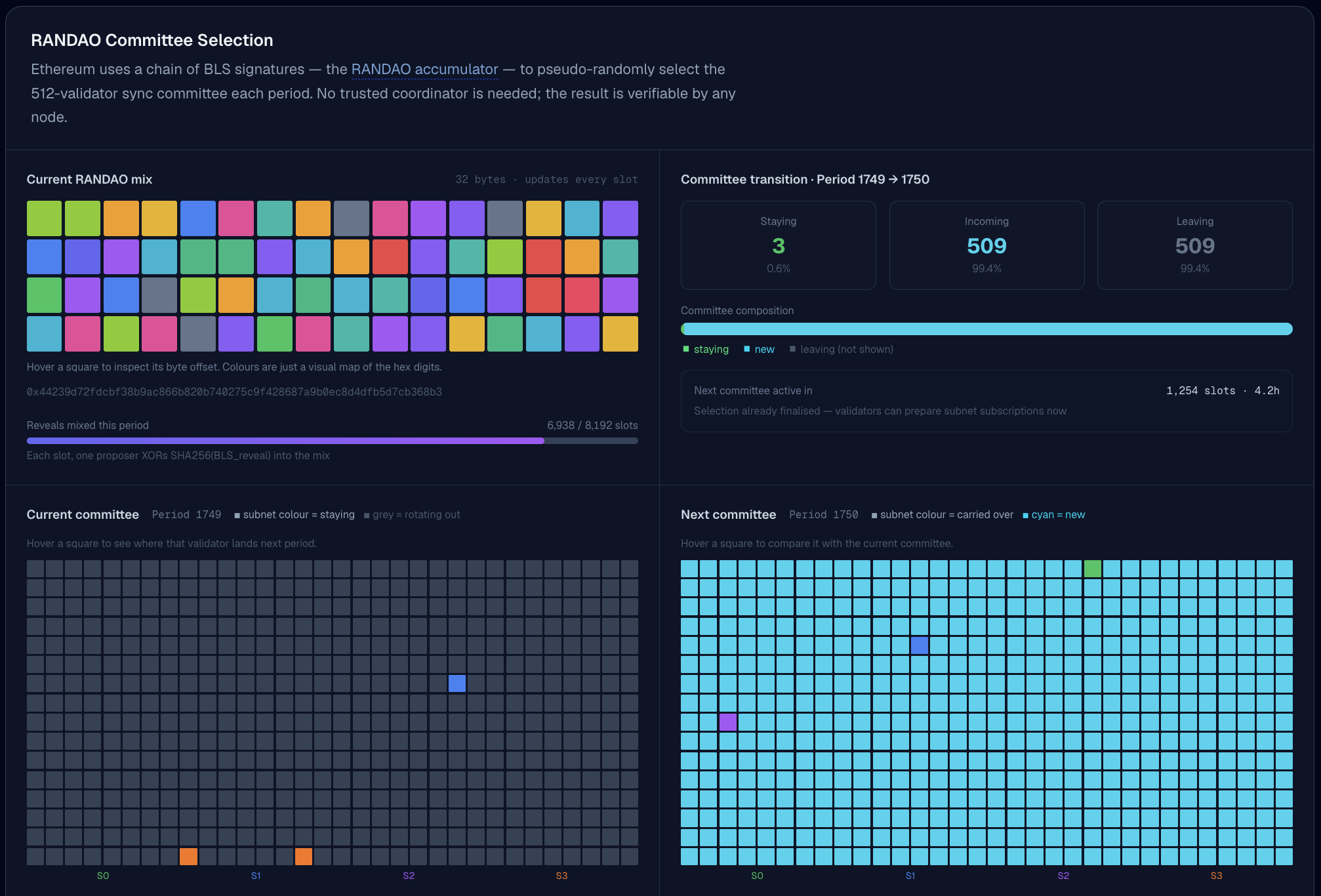
The Sync Committee is a group of 512 validators randomly selected every ~27 hours (256 epochs) to serve a specific role: they sign the most recent beacon chain block header with their BLS keys, and those signatures are aggregated into a compact proof.
That proof is what allows light clients — wallets, mobile apps, browser extensions, and embedded devices — to trustlessly verify chain state without downloading the full chain. Light clients check that a supermajority of the Sync Committee signed off on a given block head, and use that as their source of truth.
It's a critical piece of Ethereum's trust model, particularly as the ecosystem pushes toward truly decentralised, self-sovereign clients that don't rely on centralised RPC providers.
Why participation rates matter
Sync Committee participation isn't just a vanity metric. If too many of the 512 selected validators go offline or fail to sign, the aggregated signature becomes weaker — and light clients may struggle to verify chain state reliably.
The Ethereum spec expects a near-perfect participation rate under normal network conditions. Drops in participation can indicate:
- Validator client bugs or misconfigurations
- Network partitions affecting a cohort of validators
- Infrastructure issues at a specific operator or cloud region
- Protocol-level edge cases in BLS aggregation
Watching the numbers over time builds intuition about what "healthy" looks like — and helps surface anomalies before they become problems.
What ethsync.wtf shows
The dashboard updates every 12 seconds (one Ethereum slot) and surfaces:
- Current sync committee slot and epoch progress
- Live participation rate — how many of the 512 validators are actively signing
- BLS aggregation metrics — the quality and completeness of the aggregated signature
- Beacon node connectivity — chain head data via the standard Beacon API, powered by PublicNode infrastructure
Everything is read-only and runs directly against the Ethereum consensus layer. There's no middleware database, no proprietary indexing, no API keys required — just a live feed from the protocol itself.
The light client angle
The Sync Committee exists because of light clients. Post-Merge Ethereum separates the data availability problem (full nodes) from the trust verification problem (light clients). The Sync Committee bridges the gap: a rotating group of validators whose BLS signatures are cheap to verify but expensive to forge.
This design enables a category of applications that couldn't exist before:
- Mobile wallets that verify their own RPC responses
- Browser-based dApps that don't blindly trust Infura or Alchemy
- Hardware wallets that can check chain state offline
- Cross-chain bridges that verify Ethereum state without a full node
Monitoring the Sync Committee is, in a sense, monitoring the health of that entire light-client trust chain.
Why we built it
At BlockRocket we spend a lot of time building on Ethereum infrastructure — writing smart contracts, indexing on-chain data, and debugging consensus-layer edge cases. During some work on light client integrations we kept asking the same question: is the Sync Committee actually healthy right now?
There was no quick answer. The Beacon API exposes all the raw data, but turning it into a readable, updating dashboard takes work. We built ethsync.wtf as a sharp tool to answer that question at a glance.
It's also a useful educational reference. The Sync Committee is well-documented in the Ethereum consensus specs, but seeing the numbers move in real time connects the theory to the practice in a way static docs can't.
Technical notes
The dashboard speaks directly to the Beacon Node API — specifically the /eth/v1/beacon/states/{state_id}/sync_committees and related endpoints. Slot timing comes from the chain's own genesis data, so there's no clock-skew issue. The 12-second refresh aligns to the Ethereum slot interval, so you're always seeing the latest attested data.
BLS signature aggregation is handled entirely on-chain by the validators themselves — the dashboard just reads the result. The underlying crypto is BLS12-381, the same curve used throughout Ethereum's consensus layer.
Try it
ethsync.wtf — no wallet, no login, no setup. Just Ethereum's Sync Committee, live.
If you're building light client integrations, validator tooling, or anything that depends on the Ethereum consensus layer behaving correctly, keep a tab open. It's a good signal.
For questions or feedback, reach out via blockrocket.tech.